

Welcome to today’s Battle Royale featuring two roofing heavyweights: “Cool Roof Coatings” in the east corner versus “Reflective Membrane Roofing” in the west!
Tonight’s showdown pits these contenders against each other across six punishing rounds designed to test every aspect of their performance for Energy Bill Savings.
At stake? Millions in potential costs, decades of building protection, and the critical performance demands of modern commercial and industrial facilities.
Our professional judging panel will evaluate each round on technical merit, real-world performance, and value delivery. After all six rounds, we’ll declare our ultimate champion.
Ladies and gentlemen, facility managers and building owners… it’s time to rumble!
ROUND 1: INITIAL COSTS & INSTALLATION
When selecting a commercial roofing solution, the initial investment and installation process can make or break your energy-saving potential. According to Lawrence Berkeley National Laboratory, proper cool roofing choices can reduce air conditioning costs by up to 15% and save commercial buildings up to $0.20 per square foot annually. (source: Lawrence Berkeley National Laboratory)
Material Expenses
Cool roof coatings typically cost between $2-4 per square foot for materials, making them an economical choice for many commercial properties. The coating system often requires minimal substrate preparation, further reducing material costs.
Reflective membrane materials generally run $4-8 per square foot, with additional expenses for adhesives, fasteners, and supplementary materials. The higher quality and durability of membrane materials contribute to these increased costs.
While both options deliver energy-saving benefits, cool roof coatings offer significantly lower material costs. Therefore, cool roof coatings gain the “ADVANTAGE” in material expenses.
Installation Complexity
Cool roof coatings can usually be applied directly over existing roofing systems after basic cleaning and repairs. The straightforward application process requires minimal specialized equipment and can often be completed by in-house maintenance teams with proper training.
Reflective membrane installation demands extensive preparation, including potential removal of existing roofing layers. The process requires specialized tools, precise seam welding, and careful attention to flashing details.
With its simpler application process and fewer technical requirements, cool roof coatings earn the “ADVANTAGE” in installation complexity.
Project Timeline
Cool roof coating projects typically take 2-4 days for an average commercial building, with minimal disruption to daily operations. The quick-drying formulas allow for rapid completion and almost immediate building use.
Reflective membrane installations usually require 1-2 weeks for similar-sized projects. Weather delays, extensive prep work, and precise installation requirements can extend these timelines significantly.
The faster completion time and reduced operational impact give cool roof coatings the clear “ADVANTAGE” in project timeline considerations.
ROUND 1 WINNER: Cool Roof Coatings
ROUND 2: DURABILITY & LIFESPAN
When evaluating commercial roofing solutions, durability and lifespan directly impact both immediate energy savings and long-term facility costs. Lawrence Berkeley National Laboratory estimates that implementing cool roofing materials on 80% of U.S. commercial buildings could save 10,400 GWh in cooling energy, translating to approximately $735 million in overall energy savings. (source: Sika USA)
Weather Resistance
Weather resistance determines how well a roofing system maintains its protective and energy-saving properties over time. Extreme temperatures, UV exposure, and precipitation can significantly impact performance and longevity.
Cool roof coatings provide excellent UV reflection but can be vulnerable to ponding water and severe weather events. Their effectiveness typically diminishes over time as the coating weathers, requiring periodic reapplication to maintain optimal performance.
Reflective membranes offer superior resistance to weathering, featuring reinforced materials that withstand extreme conditions. Their seamless installation and robust composition provide lasting protection against UV damage, rain, and temperature fluctuations.
For weather resistance, reflective membrane roofing claims the “ADVANTAGE” due to its superior durability in harsh conditions.
Maintenance Requirements
Regular maintenance ensures optimal energy efficiency and extends the useful life of any roofing system. The frequency and complexity of required maintenance directly affect operational costs.
Cool roof coatings need regular inspections and periodic recoating every 5-10 years to maintain their reflective properties. Surface cleaning and touch-ups are essential to preserve energy-saving benefits.
Reflective membranes require minimal ongoing maintenance beyond routine inspections. Their durable construction resists degradation, and repairs are typically limited to addressing mechanical damage or seam issues.
With lower maintenance demands and longer intervals between major services, reflective membrane roofing earns the “ADVANTAGE” in maintenance requirements.
Expected Lifespan
A roofing system’s lifespan determines its long-term value and return on investment. Longer-lasting solutions often prove more cost-effective despite higher initial costs.
Cool roof coatings typically last 5-10 years before requiring substantial recoating. While reapplication is straightforward, the recurring expense and shorter service life impact total ownership costs.
Reflective membranes commonly last 20-30 years with proper maintenance. Their robust construction and superior weather resistance contribute to an extended service life that maximizes energy savings.
The significantly longer lifespan gives reflective membrane roofing the clear “ADVANTAGE” in this category.
ROUND 2 WINNER: Reflective Membrane Roofing

ROUND 3: PERFORMANCE FACTORS
In today’s energy-conscious market, the performance of commercial roofing systems directly impacts both operational costs and environmental footprint. With summer cooling costs often accounting for 40% of building energy expenses, choosing between cool roof coatings and reflective membranes can mean the difference between profitable operations and budget-crushing utility bills.
Thermal Performance
A roof’s thermal performance determines how effectively it manages heat transfer and impacts a building’s energy consumption. Roofs with efficient thermal properties can dramatically reduce the load on HVAC systems, especially during peak cooling seasons.
Cool roof coatings can reduce roof surface temperatures by up to 100°F compared to traditional dark roofing materials, delivering energy savings between 10-70%. These coatings excel at reflecting sunlight and releasing absorbed heat, making them particularly effective in warm climates. (source: American Coatings Association)
Reflective membranes provide consistent thermal performance through their integrated reflective properties. Their factory-controlled manufacturing ensures uniform heat reflection across the entire surface, though they may not achieve the same peak reflection rates as fresh coatings.
With superior peak reflectivity and customizable application options, cool roof coatings earn the “ADVANTAGE” in thermal performance.
Weather Impact Resistance
A roof’s ability to maintain its thermal properties under varying weather conditions directly affects long-term energy savings. Degraded performance can lead to unexpected spikes in cooling costs and compromise building comfort.
Cool roof coatings can be vulnerable to weathering effects, particularly in areas with frequent precipitation or extreme temperature swings. Their performance may decline as environmental factors wear down the reflective surface.
Reflective membranes typically maintain their thermal properties despite harsh weather conditions. Their multi-layer construction and superior durability help preserve energy-saving characteristics even after years of exposure.
Due to consistent performance in challenging conditions, reflective membrane roofing claims the “ADVANTAGE” in weather impact resistance.
Energy Bill Impact
The real-world effect on monthly energy bills determines the practical value of any roofing solution. This impact varies based on climate, building use, and system performance over time.
Cool roof coatings deliver impressive initial energy savings but may require periodic renewal to maintain peak performance. Their effectiveness can fluctuate as the coating ages, potentially leading to gradual increases in cooling costs.
Reflective membranes typically provide steady energy savings throughout their lifespan. While their initial impact might be slightly lower than fresh coatings, their consistent performance often results in more predictable long-term utility costs.
Given their reliable long-term savings, reflective membrane roofing earns the “ADVANTAGE” in energy bill impact.
ROUND 3 WINNER: REFLECTIVE MEMBRANE ROOFING
ROUND 4: MAINTENANCE REQUIREMENTS
Proper maintenance can make or break a commercial roof’s energy-saving potential. While many property owners focus on initial installation costs, maintenance requirements often determine the true long-term value of a roofing system. According to Lawrence Berkeley National Laboratory, commercial buildings can save up to $0.20 per square foot annually in energy costs – but only when roofing systems are properly maintained to preserve their reflective properties. (source: Lawrence Berkeley National Laboratory)
Regular Inspection Requirements
Regular inspections serve as the foundation for maintaining any roofing system’s energy-saving capabilities. These checks help identify potential issues before they compromise performance and allow for timely interventions that preserve reflective properties.
Cool roof coatings typically require visual inspections twice per year, with special attention to areas prone to ponding water or heavy foot traffic. The simple surface structure makes problems easy to spot and document during routine walkthroughs.
Reflective membranes demand quarterly inspections to check seam integrity, flashings, and potential membrane separation. These examinations often require specialized knowledge to identify subtle signs of deterioration that could affect energy performance.
With simpler inspection requirements and easier problem identification, cool roof coatings earn the “ADVANTAGE” in this category.
Cleaning and Surface Care
Surface cleanliness directly impacts a roof’s ability to reflect solar radiation and maintain energy efficiency. Dirt, debris, and environmental pollutants can significantly reduce reflective properties if left unchecked.
Cool roof coatings can be cleaned using standard pressure washing equipment and mild detergents. The smooth surface allows for quick removal of contaminants without risking damage to the coating system.
Reflective membranes require specialized cleaning procedures to avoid damaging seams or disturbing the membrane’s attachment to the substrate. The process often demands professional services and specific cleaning agents.
Due to simpler cleaning requirements and lower associated costs, cool roof coatings claim the “ADVANTAGE” in surface care.
Repair Procedures
The complexity and frequency of repairs directly affect both maintenance budgets and ongoing energy performance. Simple repair procedures help maintain optimal reflection rates and minimize system downtime.
Cool roof coating repairs involve straightforward patching and recoating of damaged areas. Most repairs can be completed by in-house maintenance teams using readily available materials.
Reflective membrane repairs require specialized tools and expertise to maintain watertight seams and preserve system integrity. Even minor repairs often necessitate professional intervention.
With more straightforward repair procedures and lower skill requirements, cool roof coatings secure the “ADVANTAGE” in repair procedures.
ROUND 4 WINNER: Cool Roof Coatings
ROUND 5: SUSTAINABILITY CREDENTIALS
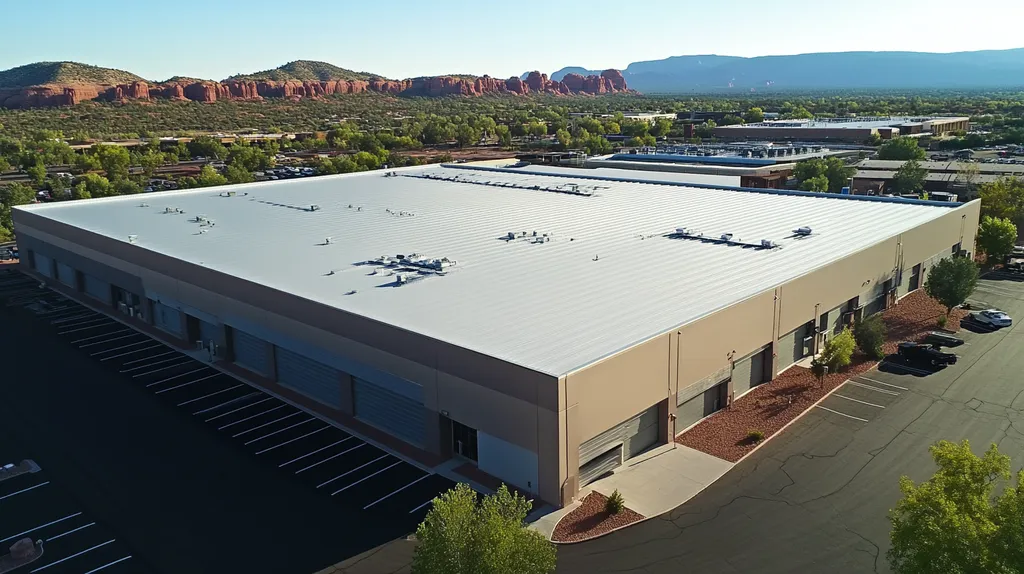
As commercial buildings account for nearly 40% of U.S. energy consumption, the sustainability impact of roofing choices has never been more critical. Every square foot of commercial roofing represents an opportunity to reduce energy usage, cut carbon emissions, and demonstrate environmental leadership. Installing a white roof on a commercial building can yield annual energy savings worth up to $0.20 per square foot. (source: Lawrence Berkeley National Laboratory)
Environmental Impact
The environmental footprint of commercial roofing extends far beyond the installation day. From raw material sourcing to end-of-life disposal, every aspect of a roofing system affects its overall sustainability profile.
Cool roof coatings require minimal raw materials and can often be applied over existing surfaces, reducing landfill waste. Their water-based formulations typically contain lower levels of volatile organic compounds (VOCs) compared to traditional roofing materials.
Reflective membranes demand more intensive manufacturing processes and often require complete removal of existing roofing materials. However, their materials are frequently recyclable and can be repurposed at end-of-life.
With lower manufacturing impact and reduced waste, cool roof coatings earn the “ADVANTAGE” in environmental impact.
Carbon Footprint Reduction
A roof’s ability to reduce building energy consumption directly affects its contribution to greenhouse gas emissions. The most sustainable solutions deliver consistent performance while minimizing operational carbon output.
Cool roof coatings create an immediate reduction in cooling energy needs, typically lowering a building’s carbon emissions by 15-20%. Their simple application process requires minimal equipment and energy usage.
Reflective membranes provide steady energy savings but require more energy-intensive manufacturing and installation processes. Their transportation footprint tends to be larger due to material bulk.
Given their superior immediate impact and simpler carbon profile, cool roof coatings claim the “ADVANTAGE” in carbon footprint reduction.
Sustainable Life Cycle
The complete life cycle of a roofing system determines its true environmental impact. This includes manufacturing, installation, maintenance, and eventual disposal or recycling.
Cool roof coatings can be renewed multiple times without removal, extending the life of underlying roofing materials. Their maintenance typically requires minimal resources and produces little waste.
Reflective membranes offer excellent durability but eventually require complete replacement. While many components can be recycled, the removal and replacement process consumes significant resources.
The ability to renew without replacement gives cool roof coatings the “ADVANTAGE” in sustainable life cycle.
ROUND 5 WINNER: Cool Roof Coatings
ROUND 6: SPECIALIZED APPLICATIONS
When it comes to specialized commercial roofing applications, choosing the wrong solution can devastate your energy savings potential. Each building type and climate zone presents unique challenges that demand specific performance characteristics. The Department of Energy reports that implementing appropriate cool roofing solutions can dramatically reduce air conditioning needs while qualifying buildings for valuable utility and government rebates. (source: Department of Energy)
Application in Hot Climates
Hot climate installations face unique challenges where surface temperatures can exceed 180°F on traditional roofs. These extreme conditions place enormous strain on cooling systems and energy efficiency.
Cool roof coatings excel in hot environments, reducing surface temperatures by up to 100°F through superior solar reflection. Their ability to be applied in thicker layers where needed provides additional insulation benefits in the most sun-exposed areas.
Reflective membranes offer consistent performance in hot conditions but lack the application flexibility of coatings. Their factory-controlled thickness cannot be adjusted for particularly challenging areas.
For hot climate applications, cool roof coatings earn the clear “ADVANTAGE” through superior temperature reduction and application flexibility.
Urban Heat Islands
Urban environments create unique challenges where concentrated development and reduced vegetation lead to significantly higher ambient temperatures. These conditions can increase cooling demands by up to 20% compared to suburban locations.
Cool roof coatings provide immediate urban heat island mitigation through their high solar reflectance. Their ability to be reapplied and maintained easily helps preserve these benefits over time.
Reflective membranes contribute to heat island reduction but offer less flexibility in addressing location-specific hot spots. Their uniform properties may not adequately address varying exposure levels across complex urban roofscapes.
Given their superior adaptability to urban conditions, cool roof coatings claim the “ADVANTAGE” in urban heat island applications.
Specific Industry Needs
Different industries require distinct roofing solutions based on their operations, equipment loads, and environmental factors. Food processing facilities, data centers, and manufacturing plants each present unique challenges for energy-efficient roofing.
Cool roof coatings can be customized with varying thicknesses and formulations to address specific industrial requirements. Their ability to be modified on-site ensures optimal performance for particular facility needs.
Reflective membranes provide reliable performance but offer limited customization options for specialized industrial applications. Their standardized construction may not ideally suit every industrial scenario.
The superior customization potential gives cool roof coatings the “ADVANTAGE” in meeting specific industry needs.
ROUND 6 WINNER: Cool Roof Coatings
AND THE WINNER IS…
After six grueling rounds of technical evaluation, we have our verdict! With a commanding 4-2 victory, COOL ROOF COATINGS claims the Energy Bill Savings Championship belt!
This heavyweight champion dominated with superior performance in initial costs, maintenance simplicity, sustainability credentials, and specialized applications. Its ability to deliver quick installation, straightforward repairs, and exceptional hot climate performance proved decisive in securing the title.
But don’t count out our runner-up! Reflective Membrane Roofing showed impressive strength in durability and weather resistance. For buildings requiring extended service life with minimal maintenance intervention, this contender remains a formidable choice.
IMPORTANT NOTICE: Every commercial property represents its own unique match-up. Local climate conditions, building specifications, and operational requirements can significantly impact roofing performance. While this analysis provides general guidance, it cannot account for all variables. Property owners should always consult qualified roofing professionals who can evaluate their specific situation and recommend appropriate solutions.
Ladies and gentlemen, in the high-stakes arena of commercial roofing, there’s no substitute for informed decision-making. The true victory comes not just from choosing a champion, but from selecting the solution that best answers your building’s unique challenges. Now, let’s see those energy bills drop!
FREQUENTLY ASKED QUESTIONS
Q. What are the initial costs of a commercial roof?
A. The initial costs of cool roof coatings range from $2-4 per square foot. In contrast, reflective membranes typically range from $4-8 per square foot. Considering both material prices and installation expenses can help you identify the most economical option for your building.
Q. How long do commercial roofs last?
A. Cool roof coatings usually last between 5-10 years, necessitating periodic reapplication. In contrast, reflective membranes can last 20-30 years with proper maintenance. Your choice will influence long-term value and replacement costs, so consider lifespan when making a decision.
Q. Which roofing option performs better in terms of energy efficiency?
A. Cool roof coatings can reduce surface temperatures by up to 100°F, leading to significant energy savings. However, reflective membranes maintain consistent thermal performance over time. Choosing the right type is crucial to maximizing energy efficiency for your commercial building.
Q. What are the maintenance requirements for a commercial roof?
A. Cool roof coatings require biannual visual inspections and periodic cleaning. Reflective membranes, on the other hand, demand quarterly checks and may require professional cleaning. Regular maintenance is key to prolonging your roof’s energy-saving capabilities and lifespan.
Q. How do these roofs impact sustainability?
A. Cool roof coatings have a lower manufacturing impact and produce less waste, making them more sustainable. Reflective membranes are recyclable but require more resources for manufacturing and installation. Understanding these impacts can guide your choices for sustainable building practices.
Q. Are cool roof coatings suitable for all climates?
A. Cool roof coatings excel in hot climates, significantly reducing surface temperatures. However, in areas with frequent severe weather, reflective membranes may perform better due to their durability. Choosing the right roofing system depends on your building’s location and climate conditions.
Q. Can I apply a cool roof coating over an existing commercial roof?
A. Yes, cool roof coatings can often be applied directly over existing roofing systems after basic cleaning. This feature simplifies the installation process, making it a convenient option for property owners looking to enhance energy efficiency without extensive renovations.






